

A standard 5–10 page business website usually takes 3–6 weeks from signed scope to launch. Custom-coded sites with integrations can take 6–10 weeks. So how long does it take to build a website for your business? It depends on scope, and on how quickly content and decisions arrive. This guide covers each phase, what delays a launch, and what keeps a project on schedule.
The short answer
A standard 5–10 page WordPress or Webflow website usually takes 3–6 weeks from signed scope to launch. Custom-coded builds with integrations can take 6–10 weeks, depending on complexity. A website build timeline is the time between agreeing the scope and having a live, tested site on your own domain.
Key facts
| Fact | Value | Source |
|---|---|---|
| Standard 5–10 page WordPress or Webflow website | Usually 3–6 weeks from signed scope to launch | our own data |
| Custom-coded build with integrations | 6–10 weeks, depending on complexity | our own data |
| Testing window after each delivered milestone | 7 days | our own data |
| Free defect fixes after launch | 30 days | our own data |
| When work may pause | An invoice more than 7 days overdue; delivery dates move accordingly | our own data |
| Time for Google to show the new URLs after a site move | A few weeks or more for a medium-sized site | developers.google.com |
| Good loading target (Largest Contentful Paint) | Within 2.5 seconds | web.dev |
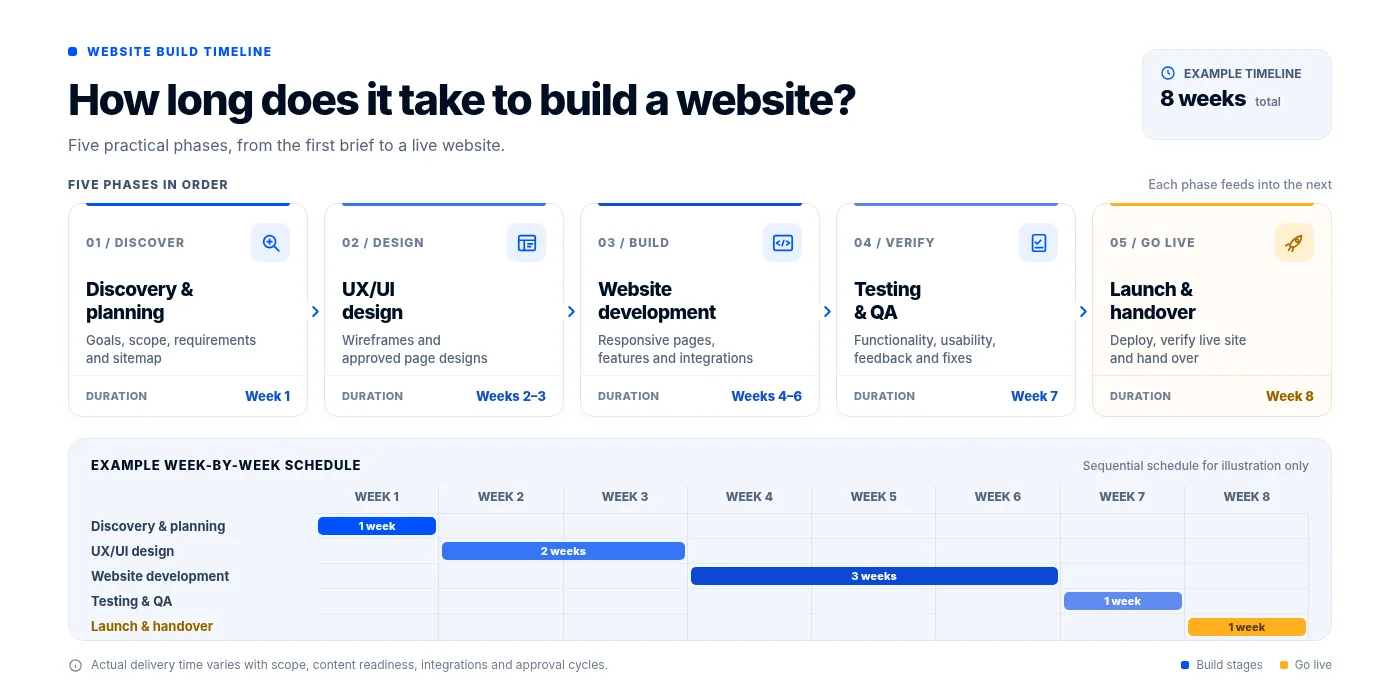
What happens in each phase of a website build?
A website build runs through seven phases, in a fixed order. Each phase builds on the one before it, so skipping ahead usually means redoing work later.
- Discovery call: we ask about the business, the audience, competitors you like and dislike, and what “done” looks like.
- Sitemap and wireframes: low-fidelity structure first, so full pages are not redesigned later because the flow was wrong.
- Design: full visual design, building on the wireframes.
- Build: development on the chosen platform, with staging links shared as sections come together.
- QA: cross-browser, cross-device and forms/integrations testing, plus a speed pass.
- Launch: DNS cutover, SSL, redirects if the site replaces an existing one, and analytics verification.
- Optional SEO handoff: for clients moving into ongoing organic growth.
After each delivered milestone, the client has a 7-day testing window. Planning for those review windows from the start keeps launch dates realistic.
Why do website projects take longer than planned?
Website projects usually run late because of inputs, not code. These five things slow a build:
- Content (text, photos, logos) arriving late.
- Slow feedback, or many rounds of changes.
- Overdue invoices: we may pause work if an invoice is more than 7 days overdue, and delivery dates move accordingly.
- New features added after scope is agreed.
- Business details and claims not confirmed before launch, such as address, legal details, licences and “free quote” wording.
New features added mid-project are the hardest delay to absorb. A new feature can touch design, build and QA again, not just one step.
What actually blocks a website launch?
Unconfirmed business details block launches more often than unfinished code. Our founder saw this first-hand on a recent service-business website for the Australian market. The launch checklist items marked as blocking launch were not code at all.
- Business details: address, contact details and legal details.
- Claims the owner had to stand behind: licensed work, accreditation and “free quote” wording.
Only the business owner can confirm these items, not the developer. Collecting them at the discovery call stops them from surfacing in the final week before launch.
Why does a custom-coded website take longer?
A custom-coded website takes longer because more of it is built from scratch, including admin tools and integrations. Custom builds with integrations can take 6–10 weeks, compared with 3–6 weeks for a standard WordPress or Webflow site.
Kuldipsinh Chauhan, Eqvanto's founder, has seen that range first-hand. It includes lean PHP and MySQL sites with a custom blog admin, and a custom Laravel application with its own admin panel and blog. Larger sites also need their structure planned before building. One consultancy site was built in phases to 62 pages, with no orphan pages and a maximum click depth of 2.
How can you speed up a website build?
The fastest website builds have content ready, one decision-maker and consolidated feedback. Three habits make the biggest difference:
- Content ready at the start.
- One person who can approve decisions.
- Feedback given in one consolidated round.
Confirm business details and claims early as well. An address, a licence number or offer wording is quick to approve in week one. The same item is slow to chase in the final days before launch.
What happens on website launch day?
Launch day covers four technical jobs: DNS cutover, SSL, redirects if the site replaces an existing one, and analytics verification. The speed pass happens earlier, during QA.
Site speed has published targets to test against. Google's web.dev guide to Core Web Vitals says Largest Contentful Paint should occur within 2.5 seconds. It sets 200 milliseconds or less for Interaction to Next Paint, and 0.1 for Cumulative Layout Shift.
Redirects matter when a new site replaces an old one. Google Search Central's site move documentation recommends server-side permanent redirects, such as 301 or 308. It advises keeping them for at least a year. Google also says that for a medium-sized site it can take a few weeks or more for the new URLs to show in search instead of the old ones.
Does the work end when the website launches?
No. Launch puts the site live, but search visibility builds over months. That is why the last phase is an optional SEO handoff for clients moving into ongoing organic growth.
One site our founder worked on shows the pace. It belongs to an Australian company. Google Search Console data covers the 12 months to November 2026. The site earned about 1,090 clicks and about 110,000 impressions, with a 1% average click-through rate. Daily impressions grew from close to zero to peaks above 1,500 a day in October 2026. The average position was 25.7, so most pages still sit around page three. That is early-stage growth, not top rankings.
Eqvanto is newly launched and has no finished client case studies of its own yet.
At a glance
| Phase | What happens | What usually slows it |
|---|---|---|
| 1. Discovery call | Business, audience, liked and disliked competitors, and what “done” looks like | Business details and claims not gathered early |
| 2. Sitemap and wireframes | Low-fidelity structure, so full pages are not redesigned later | Slow feedback on structure |
| 3. Design | Full visual design, building on the wireframes | Many rounds of changes; content arriving late |
| 4. Build | Development on the chosen platform, with staging links shared | New features added after scope is agreed |
| 5. QA | Cross-browser, cross-device and forms/integrations testing, plus a speed pass | Feedback spread across several rounds instead of one |
| 6. Launch | DNS cutover, SSL, redirects if replacing a site, analytics verification | Unconfirmed address, legal details, licences or “free quote” wording |
| 7. Optional SEO handoff | Move into ongoing organic growth | Expecting top rankings straight after launch |
| Any phase | Work continues on schedule | An invoice more than 7 days overdue may pause work and move dates |
What to do next
Frequently asked questions
How long does a 5-page website take to build?
A 5-page website on WordPress or Webflow usually takes 3–6 weeks from signed scope to launch. That range covers discovery, sitemap and wireframes, design, build, QA and launch. Where a project lands in the range depends on how quickly content, feedback and business details arrive. Content ready at the start and one person approving decisions both shorten it.
Does AI make building a website faster?
AI tools can speed up drafting, but they do not remove the steps that usually set the launch date. Someone still has to supply content, approve decisions, confirm business details and test the site across browsers and devices. On a recent Australian service-business site, the launch blockers were unconfirmed details and claims, not code. Faster code alone would not have moved that date.
How long after launch will my website appear on Google?
There is no fixed date; search visibility builds over months, not days. If a new site replaces an old one, Google Search Central says it can take a few weeks or more for a medium-sized site to be moved in search. On one Australian site our founder worked on, daily impressions grew from close to zero to peaks above 1,500 a day over 12 months.
What should I prepare before a website project starts?
Prepare your content, one decision-maker and confirmed business details. Content means page text, photos and logos. Business details include your address, contact and legal details, licences, and any offer wording such as “free quote”. Having these ready at the start removes several of the reasons a launch date moves.
What happens if I want new features after the scope is agreed?
New features added after the scope is agreed extend the timeline, and delivery dates move. A new feature can send work back through design, build and QA. The cleaner option is to list must-have features at the discovery call. Ideas that come up later can be planned as a separate phase after launch.
Related reading
Sources
- Google's web.dev guide to Core Web Vitals (web.dev)
- Google Search Central's site move documentation (developers.google.com)