
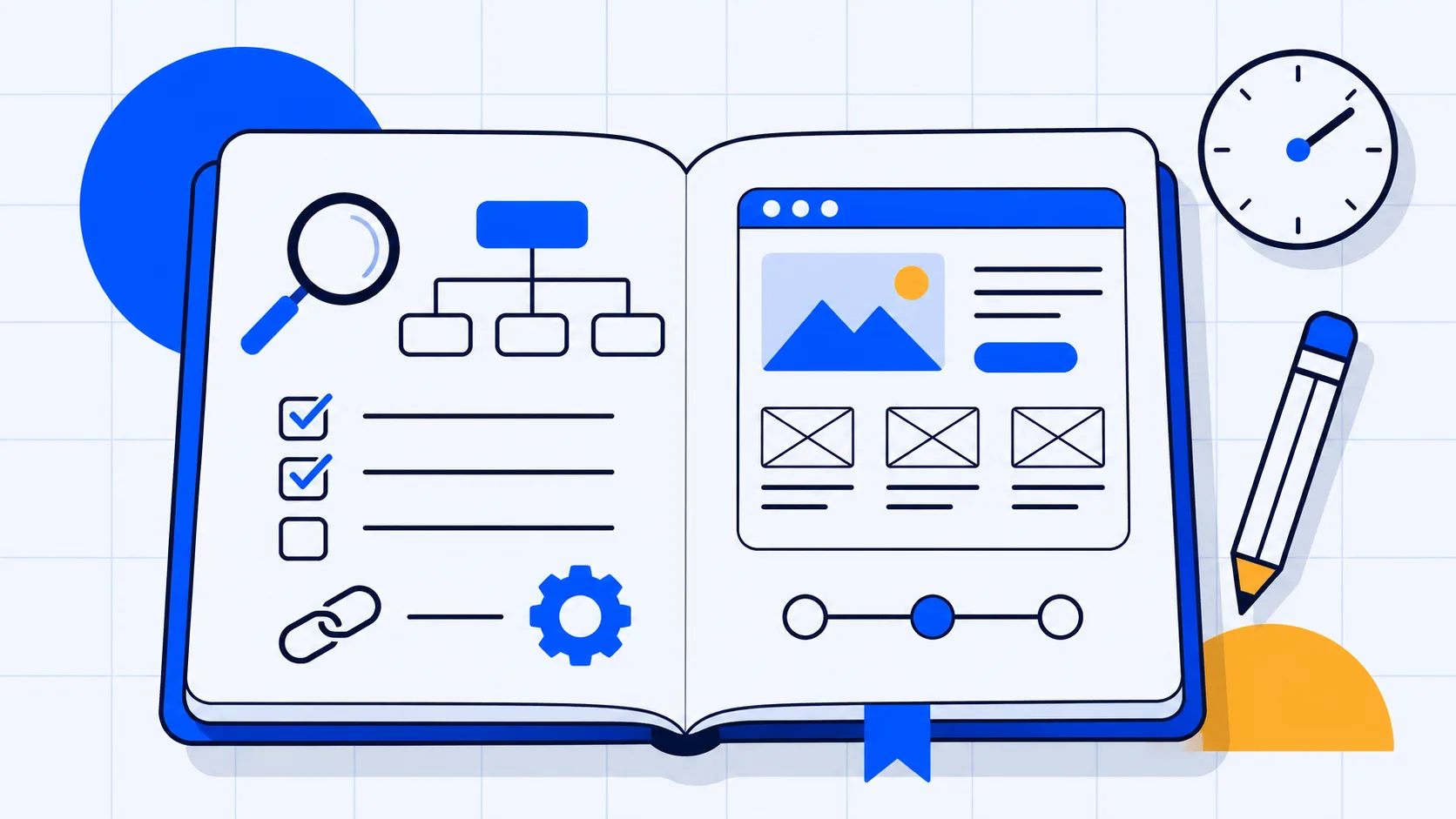
SEO-friendly website design means search engines can find, crawl and understand every page, and people can use the site on any device. Most of that work happens before any visual design starts. This guide is for founders and small business owners briefing a web design project. It covers structure, on-page basics, speed, redesigns and launch checks, with the specific questions to ask your designer.
The short answer
A website design is SEO-friendly when its structure, code and content let search engines find and understand every page, on any device. The design is not just how pages look. It is how pages are organized, linked, labelled and loaded.
An SEO-friendly build usually has six traits:
- Planned structure: a sitemap and wireframes agreed before visual design.
- Internal links: every page linked from at least one other page, with no orphan pages.
- On-page basics: title tags, meta descriptions, header structure and image alt text.
- Mobile-first, fast pages: checked against Google's Core Web Vitals.
- Tracking from day one: Google Analytics (GA4) and Google Search Console set up.
- Safe redirects: old URLs mapped with 301 redirects when a site is replaced.
Key facts
| Fact | Value | Source |
|---|---|---|
| Order of work on every Eqvanto project | Discovery call, then sitemap and wireframes, before any visual design | our own data |
| On-page SEO basics in every Eqvanto build | Title tags, meta descriptions, header structure, image alt text and a submitted sitemap | our own data |
| Good Largest Contentful Paint (loading) | Within 2.5 seconds | web.dev |
| Good Interaction to Next Paint (interactivity) | 200 milliseconds or less | web.dev |
| Good Cumulative Layout Shift (visual stability) | 0.1 or less | web.dev |
| How long to keep redirects after a site move | As long as possible, generally at least 1 year | developers.google.com |
| Time for SEO changes to show in Google | Some in a few hours, others several months | developers.google.com |
| 62-page consultancy site seen first-hand by our founder | 0 orphan pages; maximum click depth of 2 from the home page | our own data |
| Pages still shown as noindex after Eqvanto's own site opened to search | About 18 | our own data |
What makes a website design SEO-friendly?
A website design is SEO-friendly when search engines can reach, read and understand each page as easily as a visitor can. Google's SEO Starter Guide describes SEO as helping search engines understand your content and helping users find your site. It also says there are no secrets that will automatically rank a site first.
An SEO-friendly design therefore removes obstacles rather than chasing tricks. Good structure, clear page labels, fast mobile pages and clean redirects are the obstacles that design decisions control. Google's guide adds that compelling, useful content will likely influence search presence more than any other suggestion in that guide.
Why should site structure be planned before visual design?
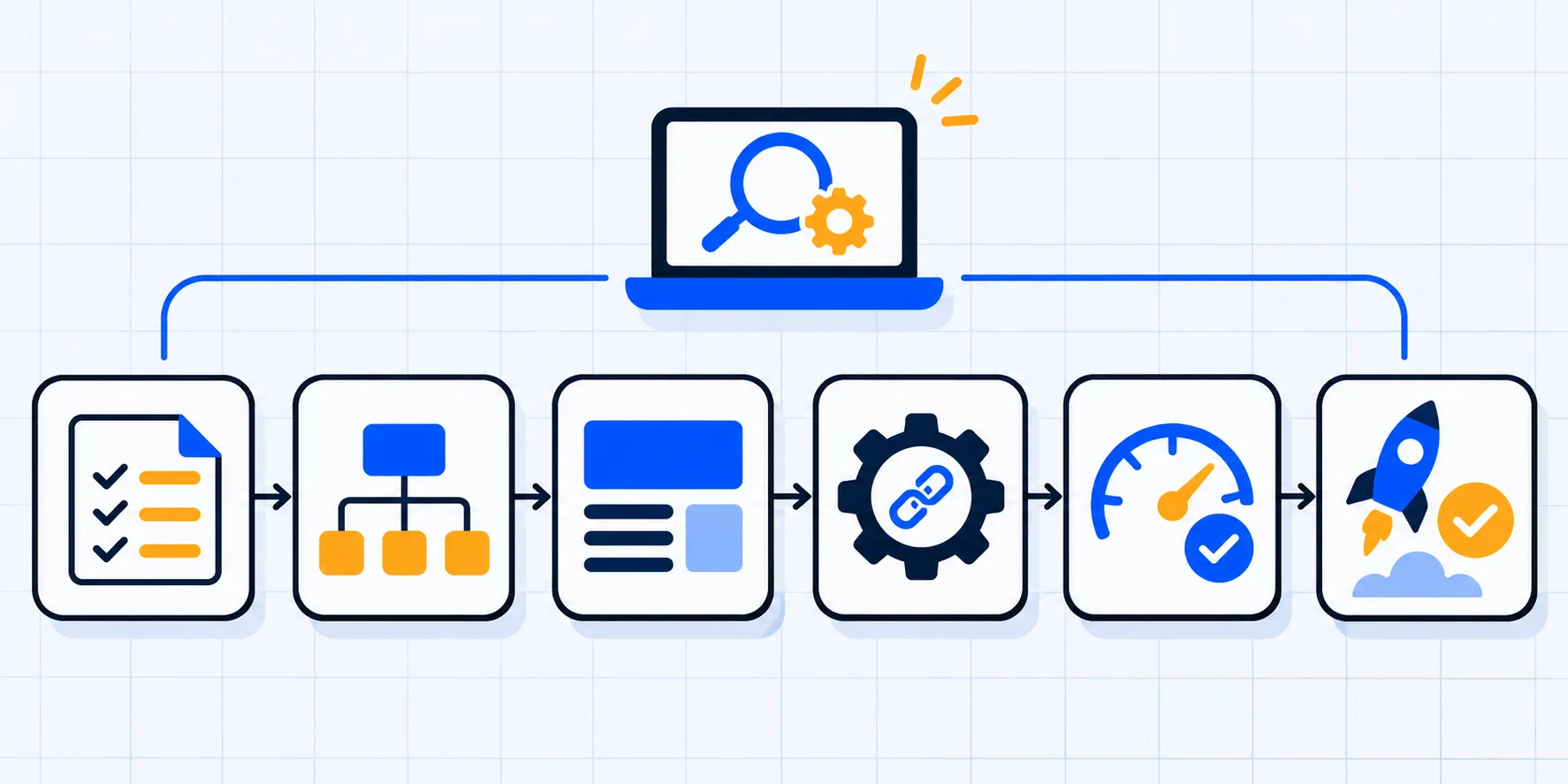
Site structure should come first because it decides which pages exist and how search engines reach them. Every Eqvanto project starts with a discovery call covering goals, audience and must-have pages. A sitemap and wireframes follow before any visual design, so the structure is agreed before pixels are spent.
Links are how pages get found. Google's SEO Starter Guide says Google primarily finds pages through links from other pages it already crawled. A page no other page links to, called an orphan page, is easy to miss.
Our founder has seen this planned well. A consultancy website was planned and built in phases to 62 pages. It had no orphan pages, and every page sat within two clicks of the home page.
Which on-page SEO elements should every page have?
Every page needs a title tag, a meta description, a clear header structure and alt text on its images. Eqvanto includes these on-page basics in every build, along with a submitted sitemap.
Google's SEO Starter Guide gives a plain test for each one. A good title is unique to the page, clear and concise, and accurately describes the page. A good meta description is short, unique to one page, and includes the most relevant points. Alt text is a short, descriptive piece of text explaining how the image relates to the content.
The same guide notes Google Search does not use the keywords meta tag. Briefs that ask for meta keywords are asking for work Google ignores.
How do speed and mobile design affect SEO?
Speed and mobile usability are baseline requirements for an SEO-friendly website, not extras. Eqvanto designs and builds mobile-first, rather than making a desktop site that “also works” on phones.
Google publishes measurable targets for page experience. web.dev's Web Vitals guide says Largest Contentful Paint should occur within 2.5 seconds. Interaction to Next Paint should be 200 milliseconds or less, and Cumulative Layout Shift 0.1 or less. The guide recommends measuring these at the 75th percentile of page loads, across mobile and desktop.
Core Web Vitals are part of Eqvanto's QA checklist on every project. QA also includes a speed pass, cross-browser and cross-device testing, and forms and integrations testing.
Which website platform is best for SEO?
The best platform for SEO is one built lean for the job the site has to do. Eqvanto builds on WordPress, on Webflow, and in hand-coded React or Next.js when a CMS cannot do the job.
On WordPress, Eqvanto uses a lean theme, either custom or lightly customised, not a heavy page-builder demo. Caching and image optimisation are set up from the start, not added after launch.
Our founder's first-hand range covers lean PHP and MySQL sites with a custom blog admin. It also includes a custom Laravel application with its own admin panel and blog. The platform name matters less to a buyer than how lean the finished pages are.
How do you redesign a website without losing rankings?
A redesign keeps earned rankings by mapping every current URL and redirecting it to its new address. When Eqvanto redesigns an existing site, we map the current URLs and set up 301 redirects, so rankings already earned are not lost.
Google Search Central's site move guide says 301 and other permanent redirects don't cause a loss in PageRank. It advises keeping redirects as long as possible, generally at least 1 year. The guide also warns against redirecting many old URLs to one irrelevant page, such as the home page.
Expect some movement anyway. Google says that for medium-sized websites, it can take a few weeks or more to start showing the new URLs.
What should you check when an SEO-friendly website launches?
At launch, check that every live page is open to search engines and that the sitemap agrees with each page. Eqvanto's launch covers DNS cutover, SSL, redirects if the site replaces an existing one, and analytics verification. GA4 and Google Search Console are set up so traffic is visible from day one.
Our own site taught us the indexing check. Eqvanto's website was closed to search engines on purpose during the build. After it opened, Search Console still showed about 18 pages as “Excluded by ‘noindex’ tag”, with a last crawl in late August. Google was holding the old closed copy and had not looked again.
The fix was to confirm each live page said “index”, then use Request indexing page by page. Google also reports a sitemap page marked noindex as an error, so the two must agree.
How soon does an SEO-friendly website show results?
An SEO-friendly website shows results gradually, over weeks to months rather than days. Google's SEO Starter Guide says some changes take effect in a few hours and others could take several months. It suggests waiting a few weeks to assess whether a change helped.
One example our founder has seen first-hand shows the pace. An Australian logistics company's website earned about 1,090 clicks and about 110,000 impressions over the 12 months to November 2026. Google Search Console showed a 1% average click-through rate and an average position of 25.7. That is early-stage growth, not top rankings.
Eqvanto is newly launched, founder-run, and has no finished client case studies of its own yet. After launch, a site can go to our SEO team with the technical groundwork already done.
At a glance
| Element | What Eqvanto does on every build | How to check it yourself |
|---|---|---|
| Site structure | Sitemap and wireframes agreed before visual design | Ask to see the sitemap before any design work starts |
| Title tags and meta descriptions | Written for each page as part of on-page basics | Check that no two pages share the same title |
| Header structure and image alt text | Set on every page | Confirm each image has a short description of what it shows |
| XML sitemap | Created and submitted | Look for it in Google Search Console's Sitemaps report |
| Mobile layout | Responsive, mobile-first design and build | Use the site on your own phone before sign-off |
| Speed | Core Web Vitals on the QA checklist, plus a speed pass | Run key pages through PageSpeed Insights |
| Tracking | GA4 and Google Search Console set up from day one | Ask for access to both on launch day |
| Redirects on a redesign | Current URLs mapped, 301 redirects set up | Open a few old URLs and confirm each lands on the matching new page |
| Indexing at launch | Analytics verification as part of launch | Search site:yourdomain.com and inspect missing pages in Search Console |
What to do next
Frequently asked questions
What does an SEO-friendly website mean?
An SEO-friendly website is one search engines can find, crawl and understand, and people can use on any device. In practice that means a planned page structure, internal links to every page, and clear title tags and meta descriptions. It also means alt text on images, fast mobile pages, and clean redirects when old URLs change.
Is an XML sitemap required for SEO?
No, an XML sitemap is not required, according to Google's SEO Starter Guide. Google says it primarily finds pages through links from pages it already crawled. A sitemap still helps, and Eqvanto submits one on every build. The sitemap must match the pages: Google reports a sitemap page marked noindex as an error.
Does heading order matter for SEO?
Heading order matters for people more than for Google. Google's SEO Starter Guide says semantic heading order is fantastic for screen readers. From a Google Search perspective, it says using headings out of order doesn't matter. A clear header structure is still part of every Eqvanto build, because readers and assistive technology rely on it.
Will a website redesign hurt my Google rankings?
A redesign does not have to hurt rankings if every old URL is redirected to its matching new page. Google says 301 and other permanent redirects don't cause a loss in PageRank. It advises keeping redirects generally at least 1 year. Expect temporary ranking fluctuation while Google recrawls the site.
Should an SEO-friendly website also be accessible?
Yes, accessibility and SEO overlap in several places, such as image alt text and clear headings. The W3C's Web Content Accessibility Guidelines (WCAG) are the international standard for web accessibility. WCAG 2.2 has 13 guidelines under four principles: perceivable, operable, understandable and robust. Its success criteria sit at three levels: A, AA and AAA.
How can I check if my website is SEO-friendly?
Start with three free checks. Search Google for site:yourdomain.com to see which pages are indexed. Use the URL Inspection Tool in Google Search Console to see how Google views a page. Run key pages through PageSpeed Insights to test Core Web Vitals. Then confirm every page has a unique title.
Related reading
Sources
- Google's SEO Starter Guide (developers.google.com)
- web.dev's Web Vitals guide (web.dev)
- Google Search Central's site move guide (developers.google.com)